We recommend book marking this page to give you instant access to it.
Nobody plans to need this page, and with any luck you never will. Lanzarote is one of the safest holiday destinations in Europe, and the overwhelming majority of visits pass without so much as a scraped knee. But knowing what to do and who to call before something happens is worth five minutes of your time, because the moment you actually need an emergency number is precisely the moment you don’t want to be searching for one. Save the key numbers below to your phone before you travel, skim the rest, and then get on with enjoying your holiday.
The Only Number You Really Need to Remember
If you take one thing from this page, make it this: the emergency number across Lanzarote, Spain and the whole of Europe is 112. It’s free to call from any phone, including mobiles without credit or a local SIM, and it connects you to the police, ambulance service and fire brigade through a single operator. The 112 call centre for the Canary Islands handles calls in English as well as Spanish, with German, French and Italian also available depending on staffing, so don’t hesitate to call because you’re worried about the language barrier. State clearly where you are, what has happened and how many people are involved, and the operator will get the right service to you.

Spain does also run separate direct numbers for the individual services, which are worth having saved as a backup, though 112 covers everything and is the one to use if in doubt.
Emergency numbers in Lanzarote
Free to call, 24 hours
Save these to your phone before you travel
| Service | Number |
|---|---|
| All emergencies (police, ambulance, fire) | 112 |
| Health emergencies / ambulance | 061 |
| National Police (Policía Nacional) | 091 |
| Local Police (Policía Local) | 092 |
| Guardia Civil (rural areas and roads) | 062 |
| Maritime rescue (Salvamento Marítimo) | 900 202 202 |
The Different Police Forces Explained
Spain runs three separate police forces, and it helps to know which is which, if only so you’re not confused by the different uniforms. The Policía Local are the municipal police, run by each town hall, and they handle local matters like traffic in town, noise complaints and minor disputes. The Policía Nacional deal with more serious crime and are also the force you’ll need for official paperwork like reporting a theft for insurance purposes, which is done at their station in Arrecife. The Guardia Civil, recognisable by their green uniforms, cover the rural areas, the highways and the coast. In practice, as a visitor you don’t need to work out which force you need. Call 112 and the right one comes to you. The only time it matters is if you need to file a police report (a denuncia) for a lost or stolen item, which we’ll come to below.
Medical Care on the Island
Medical care on Lanzarote is genuinely good, and considerably better than many visitors expect from a small island. The main public hospital is the Hospital Universitario Doctor José Molina Orosa on the outskirts of Arrecife, just off the road towards Tinajo. It’s a full modern hospital with a 24-hour accident and emergency department (look for the sign Urgencias), and it’s where an ambulance will take you in a serious situation. There’s no need to memorise the address; if it’s an emergency, call 112 and let them handle it.
For anything less than an emergency, you have two good options. Every municipality has a Centro de Salud, a public health centre that handles the everyday mishaps of holiday life: upset stomachs, infected cuts, ear trouble after swimming, that kind of thing. Your hotel or accommodation host will point you to the nearest one. If you hold a valid UK GHIC card (the replacement for the old EHIC, and existing EHIC cards remain valid until their expiry date), treatment at public facilities is covered on the same basis as for Spanish residents. Apply for the GHIC free of charge through the official NHS website before you travel, and be wary of copycat sites that charge for it. It’s worth stressing that the GHIC is not a substitute for travel insurance. It doesn’t cover private treatment, repatriation or the many things insurance does, so travel with both.
The second option is the private clinics that operate in all the main resort areas, including Hospiten’s private hospital in Puerto del Carmen. These offer fast, English-speaking treatment, but you’ll pay upfront and claim it back on your travel insurance, so keep every receipt and piece of paperwork they give you.
Pharmacies and the Duty Rota
Spanish pharmacies deserve a special mention because they can deal with far more than their UK equivalents. Look for the flashing green cross. Pharmacists here are highly trained, most in the resort areas speak good English, and they can advise on and dispense treatments for a wide range of minor ailments that would send you to a GP at home. For sunburn, insect bites, stomach trouble, hay fever and the everyday pharmacy staples, they should be your first stop rather than a clinic.
Standard opening hours are roughly 9am to 1:30pm and 5pm to 8pm on weekdays, with Saturday mornings common and Sundays generally closed. Outside those hours, a duty pharmacy system (farmacia de guardia) ensures at least one pharmacy in each area is open late or overnight on a rotating basis. Every pharmacy displays a notice in the window listing the current duty pharmacy nearby, and the rota is also published online, so if you need something at midnight there is always somewhere open on the island.
If Something Is Lost or Stolen
Lanzarote is a low-crime island, but petty theft happens in any busy tourist area, so the usual common sense applies: don’t leave valuables visible in hire cars, don’t take more than you need to the beach, and use the safe in your accommodation. If something is stolen, or you lose something valuable, you’ll need to file a police report (denuncia) if you intend to claim on your travel insurance. This is done at a Policía Nacional station, with the main one in Arrecife, and you should do it as soon as reasonably possible after the event. Bring your passport and any documentation about the stolen items. It’s an administrative process rather than an investigation in most cases, but insurers will not pay out without the report.
A lost or stolen passport is a bigger headache but a manageable one. Report it to the police and get your denuncia, then contact the British Consulate in Las Palmas de Gran Canaria, which covers the whole of the Canary Islands, on +34 928 26 25 08. They can issue an emergency travel document to get you home. This is where that photo of your passport we recommend keeping on your phone earns its place, because it makes the replacement process significantly smoother. For lost bank cards, call your bank’s emergency line immediately to freeze them, which is another number worth saving before you fly.
Emergencies on the Road
If you’re involved in a road accident, the priority order is simple. If anyone is injured, call 112 first and don’t move injured people unless they’re in immediate danger. For minor bumps with no injuries, move the vehicles out of the traffic if it’s safe to do so, and exchange details with the other driver: names, addresses, registration numbers, insurance companies and policy numbers. Most hire cars carry a European Accident Statement form in the glovebox, which both drivers complete and sign together if you agree on what happened. Photograph everything: the damage, the positions of the vehicles, the road layout and the other car’s registration. Then inform your hire company as soon as possible, using the number on your rental agreement.
If you break down, get everyone out of the car and well away from the traffic, behind the barrier if there is one, and put on the high-visibility vest that Spanish law requires every car to carry (your hire car will have one, usually in the glovebox or boot). Call the hire company’s assistance line rather than a local garage, since recovery is almost always included in your rental agreement. A few driving reminders that catch out British visitors: you drive on the right, with the moments of danger being quiet junctions and car park exits where habit takes over. Speed limits are 120 km/h on the dual carriageways, 90 km/h on open roads and 50 km/h or lower in towns, and the Guardia Civil do enforce them, with on-the-spot fines for visitors. The drink-drive limit in Spain is lower than in England, so the only sensible approach is not to drink at all if you’re driving.
Safety at the Beach and in the Sea
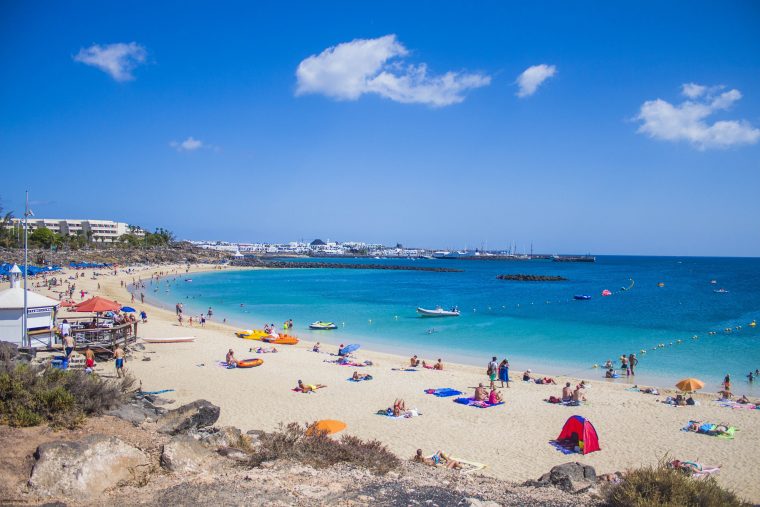
The sea causes more genuine emergencies for visitors to Lanzarote than anything else on this page, and almost all of them are avoidable. The island’s beaches use the standard flag system: green means safe to swim, yellow means caution with paddling and careful swimming only, and red means do not enter the water at all. Take the red flag seriously even when the sea looks inviting, because the dangers here are currents rather than waves, and they don’t always show on the surface. The lifeguarded resort beaches at Puerto del Carmen, Playa Blanca and Costa Teguise are the safest places to swim, particularly for families.
The beaches that demand the most respect are on the north and west coasts, above all Famara, where the Atlantic swell and strong currents make swimming genuinely dangerous for anyone who isn’t an experienced surfer under the right conditions. People get into trouble at Famara every year. If you see someone in difficulty in the water, don’t go in after them, because a double rescue is the outcome nobody wants. Call 112, alert the lifeguards if present, and throw anything that floats. For emergencies at sea itself, Salvamento Marítimo, the maritime rescue service, can be reached on 900 202 202, though 112 will route you to them just the same.
A Few Final Safety Numbers and Notes
A handful of other contacts are worth a place in your phone. The national poison information service runs 24 hours on 91 562 04 20 if a child gets hold of something they shouldn’t. Lanzarote Airport’s general information line is 928 84 60 00 for flight queries. And it bears repeating one last time, because it’s the single piece of information this page exists for: in any genuine emergency, on land or sea, day or night, the number is 112, the call is free, and English-speaking operators are available. Save it now, and here’s hoping the only reason you ever think about this page again is to tell a friend it exists.