Ways to Visit The Timanfaya National Park
| Full Day Island Tour | |
| Timanfaya National Park, Jameos del Agua & Cueva de los Verdes | |
| Timanfaya National Park Evening Tour & El Diable Dining Experience |


Bookings are made directly with the tour company. Prices, availability and any changes or refunds are handled by them, so please send booking questions their way rather than to Discover Lanzarote.
A guide to The Fire Mountains of Lanzarote
Timanfaya is the attraction that defines Lanzarote. This vast national park of craters, lava fields and volcanic cones, born of the catastrophic eruptions of the 1730s, is the most extraordinary landscape on the island and one of the most remarkable volcanic environments in the world. A visit to its heart, the Montañas del Fuego or Fire Mountains, takes you through a lunar terrain by coach, shows you the astonishing heat still lurking just beneath your feet, and lets you eat food grilled over a volcanic vent. It’s the number one thing to do on Lanzarote, and this guide covers everything you need to plan a visit, from the important changes to 2026 prices and tickets to what to expect, the camel rides, and who it suits.
What Is The Timanfaya National Park?
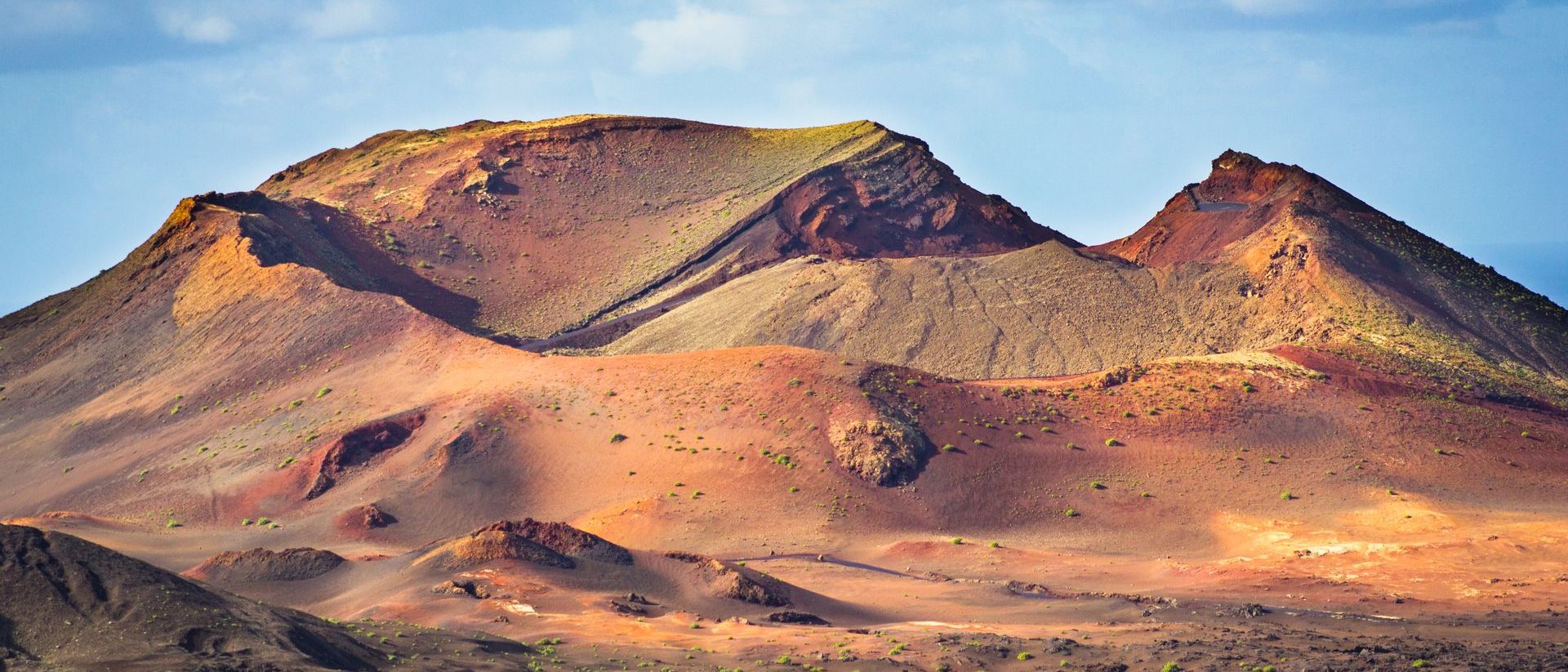
Timanfaya National Park covers a huge swathe of the centre-west of Lanzarote, and it exists because of one of the most significant volcanic events in recorded European history. Between 1730 and 1736, a series of eruptions tore the land open here, burying villages and a quarter of the island’s most fertile farmland under lava and ash, and a final eruption in 1824 added to the devastation. Nearly three centuries on, the landscape remains raw and almost entirely bare, a frozen sea of black, red and ochre craters, twisted lava and volcanic cones, with only hardy lichens clinging to the rock.
What makes Timanfaya truly unusual is that it’s still hot. The ground just below the surface holds a “geothermal anomaly”, with temperatures reaching around 250 degrees only a few metres down and over 600 degrees deeper still, making this one of the very few places on earth where you can witness that heat first-hand. The park is so otherworldly that it has been used to test equipment for planetary missions, and it’s the single biggest reason Lanzarote was declared a UNESCO Biosphere Reserve. Access to the fragile core is tightly controlled to protect it, which is why the classic visit is a guided one.

THE HISTORY OF THE TIMANFAYA NATIONAL PARK
To understand Timanfaya, you have to go back to the night of 1 September 1730, one of the most significant dates in Lanzarote’s history. Somewhere between nine and ten o’clock that evening, the ground split open near the village of Timanfaya, and what followed was one of the longest and most destructive volcanic eruptions in recorded European history; six years of near-continuous activity that would bury a quarter of the island and reshape it forever.
We know so much about it because of one remarkable man. Don Andrés Lorenzo Curbelo, the parish priest of nearby Yaiza, kept a diary of the events as they unfolded, and his eyewitness account is the only written record of the catastrophe and one of the most vivid descriptions of a volcanic eruption anywhere in history. His chronicle opens with the first night, when, as he wrote, the earth suddenly opened near Timanfaya and an enormous mountain rose from the ground with flames pouring from its summit, burning for nineteen days. He described the smoke, the ash and cinders that rained across the island, the cattle dropping dead from the fumes, and the terror of the villagers as the land itself came apart around them.

The eruptions came in waves rather than one single event. New vents kept tearing open across the centre-west of the island over the following years, sending rivers of lava creeping towards the sea and swallowing everything in their path. By the time the activity finally ceased in 1736, the lava and ash had buried somewhere in the region of a dozen villages and covered around 200 square kilometres, a quarter of Lanzarote, including some of its most fertile farmland, the old grain fields and vineyards of the Timanfaya valley. A further, smaller eruption in 1824 added a last chapter to the story. Remarkably, for all the destruction, there is no record of anyone being killed directly by the eruptions, though many islanders lost their homes and livelihoods and were forced to flee to Gran Canaria and Fuerteventura, and the hardship and famine that followed were severe.
What the volcanoes left behind is the extraordinary landscape you see today, a frozen sea of black, red and ochre lava, craters and cones stretching to the horizon, almost bare of life nearly three centuries on. Rather than a disaster to be forgotten, the islanders in time turned it to their advantage, learning to farm the volcanic ash in ingenious ways, as at the nearby La Geria vineyards, and eventually recognising that this scarred, otherworldly terrain was a wonder unlike anywhere else on earth. The whole of the eruption zone is now protected as the national park, and Father Curbelo’s diary, written in fear three hundred years ago, is now treasured as the island’s window onto the days the mountains burned.
César Manrique’s Influence on Timanfaya
While Timanfaya is first and foremost a natural wonder, César Manrique’s hand is present here too, in his characteristically restrained way. He designed the El Diablo restaurant on the Islote de Hilario, the low building at the heart of the park with a huge circular window wall framing the lava field, its interior echoing the curved stone shelters, or socos, that protect the vines in the nearby La Geria wine region.

The park’s emblem, the friendly-fierce little Devil of Timanfaya that greets you on the approach road, is also Manrique’s design, as was the concept for the coach route through the park. As at his other sites, the intervention is deliberately minimal, letting the overwhelming drama of the volcanic landscape speak for itself.
What a Visit to The Timanfaya National Park Involves
The centre of the experience is the Islote de Hilario, reached by driving into the park from the entrance at El Taro, along a road where you’re asked to stay in your vehicle to protect the environment. On arrival there’s free parking, and the visit itself has three main parts.
The first is the geothermal demonstrations, staged right there on the Islote, where staff show just how much heat lies beneath your feet. Dry brushwood dropped into a shallow pit bursts into flames within seconds, and water poured into a borehole erupts back out moments later as a roaring jet of steam. It’s a genuinely dramatic, slightly theatrical display, and children in particular love it.

The second is the Ruta de los Volcanes, the Route of the Volcanoes, a coach tour of around thirty-five minutes along a fourteen-kilometre road that winds through the very heart of the lava fields and craters, with an audio commentary. This road is accessible only by the official park coaches, so it’s the one and only way to see the interior, and for safety and conservation you remain on the coach throughout. The third, if your timing suits, is a meal at the El Diablo restaurant, where the food is grilled over a well that channels the earth’s natural heat.
The Camel Rides
One of Timanfaya’s most famous experiences is the camel ride, and it’s worth understanding how it works, because it’s separate from the main park visit. The camel rides operate from the Echadero de los Camellos, a point on the LZ-67 road before you reach the park’s ticket entrance, so you do not need a park ticket to take a ride, and equally your park ticket does not include one.

The camels, led in trains up the flank of a volcano, offer a fun and memorable perspective on the landscape and a nod to the traditional working animals of the island. A ride lasts around twenty minutes and is paid for separately on the spot. It’s an optional extra you can add before or after your main visit.
Timanfaya National Park Opening Times
Timanfaya is open every day of the year. The Montañas del Fuego is generally open from 9:00 in the morning until 4:45 in the afternoon, with the park closing later. Because it’s the island’s most popular attraction, it gets extremely busy, and in the summer months especially there can be long queues, so it’s wise to avoid the busiest window of roughly 11:00 to 1:30 and to arrive earlier or later in the day. As times can vary by season, always check the official CACT Lanzarote website before you travel.
Nearby, and quite separate, the Mancha Blanca Visitor Centre offers a free exhibition and audiovisual show about the park, is fully accessible, and makes a worthwhile first stop.
Timanfaya National Park 2026 Prices
An important change to be aware of, because many older guides and articles have it wrong: tickets for Timanfaya are now sold online in advance only, linked to a specific date and timed entry slot, and are no longer sold at the gate. You choose your arrival time when you book, and you should arrive at the ticket office fifteen minutes before your slot.
The standard ticket covers the geothermal demonstrations and the Route of the Volcanoes coach tour. The main 2026 prices are as follows.
| Ticket Type | Price (2026) |
|---|---|
| Adult | €30.00 |
| Child (7–12) | €15.00 |
| Child (0–6) | Free |
| Adult with disability | €21.00 |
| Child (7–12) with disability | €10.50 |
Reduced rates are available for Canarian residents (adult €24.00, child €12.00) and Lanzarote residents (€2.00) on production of the relevant physical documentation, and children under seven go free.
The camel ride, if you want it, is paid for separately at the Echadero de los Camellos. All prices include the local IGIC tax, and tickets are non-refundable and non-exchangeable, valid only for the chosen date and time, so be sure of your plans before booking.
As prices are occasionally updated, treat these as a guide and confirm on the CACT Lanzarote website.
Is The Timanfaya National Park Suitable for Children?
Timanfaya is a hit with children, and under-sevens go free. The geothermal demonstrations, with their bursts of flame and jets of steam, are the highlight for most kids, and the sheer strangeness of the lunar landscape from the coach window keeps them engaged.
The camel ride, taken separately, is another obvious draw for families. The main visit is undemanding in terms of walking, as the coach does the touring, though there are some steps and uneven ground around the Islote de Hilario, and the exposed site can be hot and windy, so bring sun protection, water and a hat. Do keep children close on the Islote, as parts of the ground are genuinely hot and you must stay on the marked paths.
Timanfaya National Park Accessibility for Visitors with Disabilities
Timanfaya is more accessible than the island’s cave attractions, since the core of the visit is a coach tour rather than a walk, but there are still things to consider. The coach route itself is seated throughout, and the Islote de Hilario has some uneven volcanic ground and steps around the viewing and demonstration areas. Reduced-price tickets are available for visitors with a recognised disability, as shown above, and assistance dogs are permitted, while other pets are not.
There’s free parking on site. The Mancha Blanca Visitor Centre nearby is specifically noted as accessible to people with reduced mobility, so it’s a good complementary stop. If accessibility is a particular concern, it’s worth contacting CACT Lanzarote in advance to confirm exactly what you’ll be able to do on the day.
Where is the Timanfaya National Park?
Timanfaya is in the centre-west of Lanzarote, with the Montañas del Fuego entrance on the LZ-67 road that connects the villages of Yaiza and Mancha Blanca/Tinajo. It’s an easy drive from anywhere on the island. A few practical pointers: book your timed ticket online well ahead, particularly in peak season, and target an early or later slot to dodge the midday crush and the parking bottleneck.
Bring sun protection, water, a hat and a light layer, as the site is exposed and can be both hot and windy. If you’d like to eat at the El Diablo restaurant, aim your visit around lunchtime. And if the idea of driving and booking yourself feels like hassle, Timanfaya is included on many organised island coach tours, which handle the entry and transport for you. Combine it with the nearby La Geria wine region and the village of Yaiza for a superb day in the south-west.
Why Timanfaya Is A MUST Visit when you come to Lanzarote
Timanfaya is quite simply the most extraordinary place on Lanzarote, and one of the great volcanic landscapes of the world. Where else can you watch the earth spit steam on demand, ride a camel up a volcano, eat chicken grilled over natural geothermal heat, and drive through the frozen heart of an eighteenth-century eruption, all in a single morning?
It’s the reason many people come to the island, and it never fails to leave an impression. Just remember the big change, tickets are now online and timed, so book ahead, arrive outside the midday rush, and give yourself time to take in a landscape unlike anywhere else on earth.
Ways to Visit The Timanfaya National Park
| Full Day Island Tour | |
| Timanfaya National Park, Jameos del Agua & Cueva de los Verdes | |
| Timanfaya National Park Evening Tour & El Diable Dining Experience |
Bookings are made directly with the tour company. Prices, availability and any changes or refunds are handled by them, so please send booking questions their way rather than to Discover Lanzarote.